
"You got any weapons on you?” “Why would I?” Kurt asked. “I’m a werebear; the only way I could be more dangerous is if I were juggling flaming chainsaws.”
~Steve McHugh, (Prison of Hope (Hellequin Chronicles, #4))
Mythic Origins
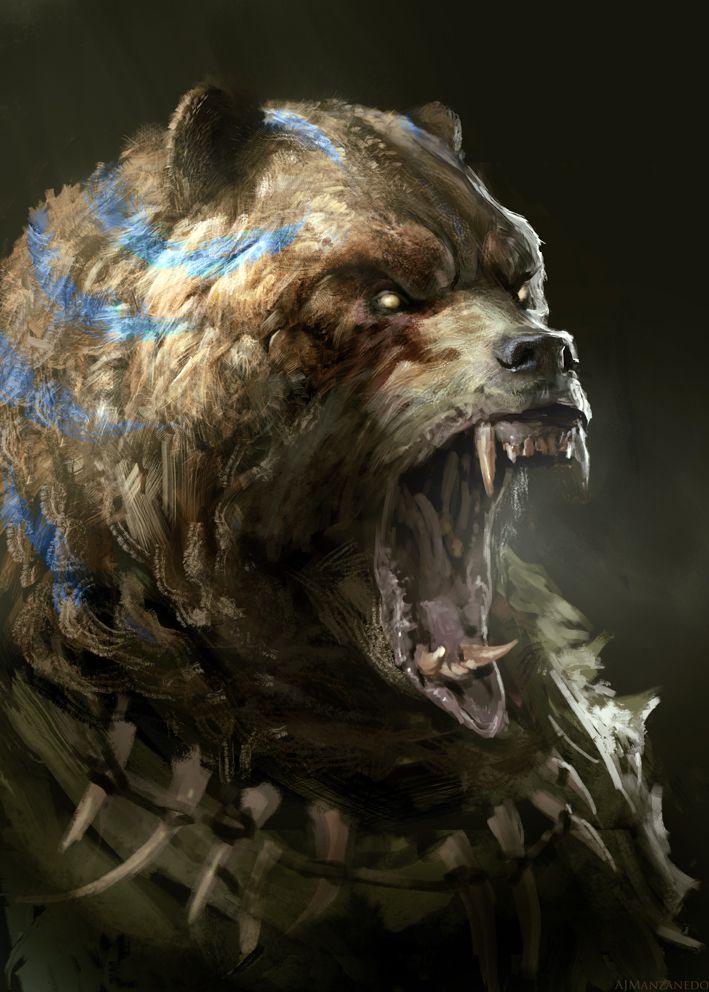
The legends of bear-men, who can slip their skin in order to become bears or to walk as men stretch back into antiquity and beyond. From the Norse Berserkr to the legend of King Arthur, bears have played a large role in the myths of humanity.
King Arthur may be among the most famous of these myths, who was sometimes called the Bear of Britain, and who helped drive off Irish, Saxon, Scottish and Picti raiders from the shores of Yns Prydein, the Island of the Mighty, otherwise known as Britain. King Arthur was considered a wise man, God’s Chosen King over all of Britain, and wielded the mighty sword Excalibur, Sword of Kings from the Dawn of Time. His exploits appear in the Mabinogi and in Geoffrey of Monmouth’s History of the Kings of Britain. Whether or not he really existed is a matter of opinion.
Whatever their ancestry bears are found around the globe, although primarily in the Northern Hemisphere, and their appearance in myth and legend is almost culturally universal everywhere that the bear exists. Modern bears seem to draw inspiration from the myths of their homelands, but they pattern their society after the legendary Arthur.
Leadership & Social Structure
A group of werebears is known as a Sleuth and is typically led by an Ursus or an Ursa, the title of males and females respectively that lead their particular sleuth. The leadership style of bears is a little different from other types of predatory lycanthropes, as the Ursus or Ursa only rules by executive fiat in times of warfare, stress, or great tribulations. Werebears have a tendency to be slower creatures, preferring careful deliberation and patient examination of the facts rather than leaping to conclusions and then into the fray.
In times of quiet and peace, when a matter comes before the Sleuth that requires action, the Ursus and/or Ursa call for a Council, and all the bears that belong to the Sleuth are called together where they deliberate, debate, and argue over the different points of view before coming to a consensus. Bears typically prefer harmony and unity and the bears prefer to act only when everyone agrees on the course of action.
In times of stress or war, however, the normally placid bears demonstrate both their resolve and their ferocity. The Ursus or Ursa appoints one bear to act as the Khan, although this is sometimes the Ursus or Ursa themselves. The Khan is responsible for the security and welfare of the Sleuth and prosecutes the war, battle, or conflict in accordance with direction from the Ursus and/or Ursa. A Khan, during war time, has complete authority over the Sleuth, and those that refuse to follow orders can expect a beating at the least, although death is a possibility for obstinate refusals to comply.
In almost every Sleuth there is a person, Werebear or otherwise, known as a Skald. The Skald is responsible for the stories of the Sleuth, for teaching the young bears what they need to know, including how to function sexually without changing shapes, and is a spinner of stories and a keeper of mysteries. The Skald almost always has magical or psychic gifts, and is generally regarded as a second in command without ever actually formally holding a rank in the Sleuth.
General Traits & Abilities
For all their fury and brute power, Werebears are not as outwardly aggressive as other predator lycans. They reserve their rage, savage bites, and crushing strength for those who have pushed too far or pose an immediate threat. Overall, bears are symbols of fortitude, their thick hides, enhanced endurance, and focused healing abilities making them bastions of perseverance as certain as the mountain stone.